
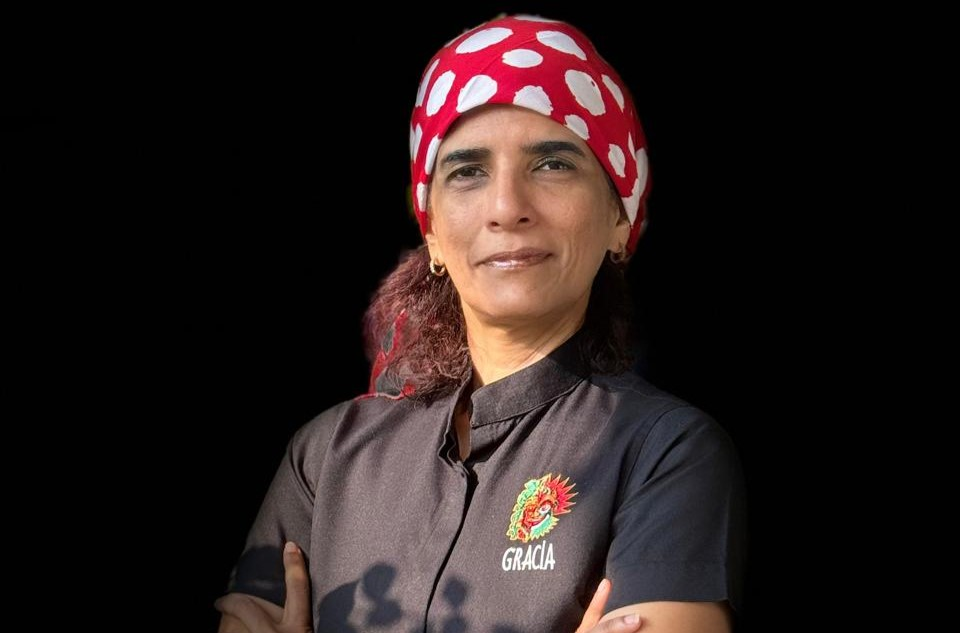
There is a version of this story that reads like a straightforward founder profile: a new entrant in India's booming agave and craft-spirits market, riding a wave of premiumisation and changing drinking habits. That version isn't wrong, exactly — it's just incomplete. The more interesting story is the one where a bottle carries a mother's photograph on its label, where soil-erosion trees became the accidental birthplace of a spirit, and where Suzann Homan speaks about flavour testing with the same seriousness she reserves for grief.
The brand itself, Gracia Viva Agave, was born from an actual family recipe — one her mother, Grace, brought home after a chance encounter with a Mexican family of distant, shared ancestry during a holiday to Mexico in the 1980s. Grace spent years recreating that drink with Indian ingredients for her own family's gatherings back in Bombay, long before it ever had a commercial name. After Grace passed away in 2024, Suzann — now a director at Kantala Spirits alongside Kiran Ullal and Keith Fernandes — decided to bring her mother's drink to the wider world, naming it Gracia, Spanish for "Grace," in her memory. What follows is less a checklist of questions than a single unspooling thread — heritage, into category, into story, into product, into what's still unsolved.
Where did the idea of a strong woman building a strong brand actually come from?
It comes directly from my mother. She passed away two years ago, but she was one of the strongest, most forward-thinking women I knew, and that spirit passed down from her own father — a pioneer in his field — through her, and then to me. We're Goan, and even though we lived in Mumbai, every vacation was spent in Goa, surrounded by traditions strikingly similar to how tequila is made in Mexico; feni is a family business here too, passed down generation to generation. My mother once travelled to Mexico and got curious about tequila, and realised how alike the two cultures were — that same camaraderie and warmth when a family sits together in the evening, or for a wedding, and shares a drink. For them it was tequila, for us it was feni. In small villages across Goa, church functions still hand every attendee a small sip of feni or port wine, and that nostalgia is exactly what I wanted to capture honestly in the brand, rather than build something purely commercial.
That same instinct is what you're now applying to agave. Harder problem, or easier one?
Honestly, it's both. When we started, people would ask why we didn't just call it tequila, not realising that name is legally protected, the same way Champagne is — so we've had to build an educational layer into everything we do, because most people simply haven't been told. I'm also quite nationalistic about this: I wanted the drink to be genuinely Indian, so we import none of our tequila and use our own Indian agave spirit entirely. And yes, feni is GI-tagged too, which this country should be proud of. Interestingly, tequila wasn't always the global category we know today either; it started small and family-owned, and took years of deliberate storytelling before the world caught on — the same way feni carries real heritage and even medicinal roots that most people still don't know about. What I do know is that this segment is growing across every age group now, not just younger drinkers; at most urban parties today, people are reaching for tequila or agave, which simply wasn't true a decade ago.
You keep coming back to authenticity. How do you protect that in such a loud, judgmental market?
I think authenticity wins over noise every time. When people sense you genuinely believe in what you're bringing to market, and that the product itself is actually good, that matters far more than clever marketing — because whatever your story is, your product has to live up to it, or none of it holds together. It's a competitive space, no doubt, but the category itself is growing fast enough that there's room for everyone, and I think competition is healthy because it forces all of us to keep improving, which ultimately benefits the consumer rather than the brands unwilling to innovate. Alcohol carries its own added challenge because of advertising restrictions, but our alcohol and non-alcoholic lines share the same identity and story by conscious design, which lets us keep the brand visible in ways alcohol marketing alone wouldn't allow. Beyond that, storytelling for me is deeply personal — it's my story, something I've actually lived, not manufactured for a campaign — and I want people to think of their own family, their own good evenings, while they're sipping a glass of feni or agave, the same way I do.
What would that ‘lived story’ look like as an actual experience, not just a bottle?
We've already started in a small way — since launching feni, we invite people to the distillery to watch the entire process, which is very similar to grape-stomping, except it's cashew apples crushed underfoot, then distilled slowly so the transformation unfolds over time rather than happening instantly. I love the history behind it too: cashew trees weren't originally planted in Goa to make feni at all, they were planted to stop soil erosion, and people only discovered feni because they noticed the fallen fruit fermenting on the ground and the birds getting happily drunk on it. That kind of accidental heritage, passed down through generations, is exactly what I want to protect and communicate, because when people hear these stories, they develop a real sense of belonging — first to the land, then to the brand itself. If I could design my dream version of this, it would be a full cashew orchard with my own distillery on-site and a small resort attached, where people could come, watch the whole process unfold, and actually stay a while rather than just pass through. It's on my mind constantly, and I'm hoping it happens.
That orchard's still a dream! So, what's pushing the product itself to keep changing?
My consumers, point blank. We go back to the market constantly for feedback, and it's taught me fast that instinct alone isn't enough — we launched with about six flavours and learned through real customer response that some things we thought would be hits fell flat, while others we'd underestimated took off. That's exactly why I listen just as closely to competitors as to customers; assuming you're operating in a vacuum is a fast way to fall behind. On flavour specifically, it's a two-part process: we lean toward things that already resonate with Indian palates — guava, or a mango-and-mishri combination that triggers genuine childhood memory — and then test relentlessly across different age groups, where a younger taster will often love something an older one rejects outright. That tension is exactly what helps us sort real winners from novelty. For me, flavour is fundamentally about nostalgia and comfort, and I won't pretend it isn't also just fun — it's the thing that catches someone's eye first on a new menu. I have no interest in becoming a bulk, mass-market player; I want to stay a sharp, niche name known for quality, and keep refining that by listening to everyone's ideas rather than my own assumptions.
Is that same consumer-first instinct behind the non-alcoholic push too?
We already play seriously in that space, and honestly, not drinking has simply become socially acceptable in a way it wasn't a decade ago — it isn't purely about calorie-counting, it's a genuine shift in social attitude. I go through months myself, during Lent or Shravan, where I don't drink at all, and where that once meant defaulting to a Coke or soda at a party, you can now hold a zero-alcohol margarita or picante with almost zero sugar and get exactly the same ritual and sense of belonging, without anyone questioning your glass. Weddings prove how far this has come, since most large ones now run a completely separate non-alcoholic bar, because hosts have realised how much of their guest list simply isn't drinking — and it isn't only younger guests either; plenty of people in their late forties and fifties are leaning more spiritual these days and don't want to feel out of place at a party because of it. That said, it's genuinely the harder side of the business, not the easier one — in alcohol, I'm competing within a fairly small, defined circle of players, while in non-alcoholic, I'm competing with absolutely everything, from water to cola to energy drinks, at any price point. But the population and appetite for this shift are both large enough that I still see it as one of the biggest growth opportunities we have, in India and globally.
With all of that in motion — what's still genuinely unsolved?
Distribution is the single biggest bottleneck in this industry, without question, and I've told my team constantly that it needs to be our primary focus. Second is regulatory standardisation, because every state has different rules — not many people know that I had my mother's photograph on the bottle as a personal dedication to her, which worked fine in Goa but had to be removed entirely when we launched in Punjab and Haryana, purely because of local regulations. Getting closer to uniformity across states is something I badly want to achieve. And the third, which is honestly closest to my heart, is that I want feni to stop being seen as just a Goa drink. Within the next year, I'd genuinely love to see it travel well beyond home, the way agave has moved from a niche, high-end category into something people reach for at any urban party — because that's ultimately the whole point of everything we're building.